
Insurance Broker vs Buying Business Insurance Direct in Canberra: What Should Business Owners Choose?

Choosing business insurance is an important decision, but deciding how to arrange that insurance can be just as important. Canberra business owners can approach an insurance company directly or work with an insurance broker who helps assess their requirements and access available insurance options.
Both approaches have advantages. Buying directly may suit a business with straightforward insurance requirements and a good understanding of the policy it needs. Working with a Canberra insurance broker may be worth considering when a business has multiple risks, specialised equipment, contractual insurance requirements or several types of cover to arrange.
The important thing is to understand what you are buying, what the policy excludes and how well it reflects your actual business activities.
An insurance broker can help businesses assess risks, compare available policies from multiple insurers and understand differences in coverage, limits, excesses and exclusions. However, the value of that service depends on the broker's market access, authorisations, experience and the support included in the engagement.
For businesses operating across Canberra and the ACT, choosing between a broker and buying directly should involve more than comparing premiums. It should involve comparing the insurance options, the service provided and the financial risks that need to be managed.
This guide explains the differences, when each approach may be suitable and what Canberra business owners should consider before arranging or renewing their insurance.
1. What Does an Insurance Broker Do?
An insurance broker acts as an intermediary in arranging insurance between clients and insurers. Depending on their authorisations and available markets, brokers can help businesses understand their insurance requirements and compare products from different insurance companies.
Unlike purchasing a policy directly from one insurer, using a broker may give a business access to multiple available insurance options through a single professional contact.
The National Insurance Brokers Association (NIBA) explains that brokers assess clients' risks, source insurance products, compare available options and assist with policy changes and renewals. Some also provide support during the claims process, depending on their service arrangements.
You can read more about the role of insurance brokers in Australia.
How Does the Process Work?
A typical business insurance brokerage process involves several stages.
Understanding your business: The broker gathers information about your operations, employees, turnover, premises, vehicles, equipment and contractual obligations.
Identifying risks: The information is used to identify insurance requirements and areas where existing policies may need reviewing.
Approaching insurers: The broker approaches relevant insurance markets available to them and obtains options for consideration.
Comparing policies: Available options are reviewed based on coverage, limits, exclusions, excesses, conditions and premiums.
Arranging cover: Once the business selects an appropriate option, the broker assists with the arrangement and policy documentation.
Ongoing reviews: Insurance may need updating when the business expands, purchases equipment, employs additional workers or changes its activities.
The exact services differ between brokerages. Business owners should understand what is included before engaging a broker.
2. Buying Business Insurance Directly From an Insurance Company
Buying directly means approaching an insurer and arranging a policy through its own sales team, website or authorised distribution channel.
This can be convenient when the business has a relatively simple insurance requirement and already understands the type of cover it needs.
For example, a small business operating a single commercial vehicle may already know which type of motor insurance it wants to purchase. It may decide to compare direct quotes from insurers and review their policy documents.
Advantages of Buying Direct
Direct communication: You deal with the insurer or its representative when requesting information, arranging the policy and discussing its administration.
Online accessibility: Some insurers provide digital quote and policy management facilities.
Straightforward requirements: A business needing one clearly defined type of cover may find the direct process relatively simple.
Control over comparison: Business owners can research different insurers independently and make their own decisions.
What Should You Consider?
The responsibility for understanding the policy remains important regardless of how it is purchased.
A direct quote may look attractive, but the business must still check what is included, the policy exclusions, coverage limits, excesses and conditions.
A low premium does not necessarily mean the policy offers the most appropriate protection.
Businesses should also consider whether they are comfortable reviewing insurance documents independently and managing questions about coverage or renewal.
3. Insurance Broker vs Direct Insurance: What Is the Difference?
The main difference is how you access, compare and arrange insurance.
A broker may help evaluate available products from several insurance markets, while a direct customer approaches the insurer or insurers they choose.
Here is a practical comparison.
ComparisonInsurance brokerBuying directInsurance optionsAvailable markets accessible to the brokerProducts offered through the chosen insurerRisk assessmentMay assist with reviewing business exposuresBusiness must explain requirements to each insurerPolicy comparisonCan compare available optionsCustomer compares insurers independentlyPolicy explanationDepends on the broker's service and authorisationInsurer or representative explains its productSpecialised risksMay help source relevant specialist marketsDepends on insurer's underwriting appetiteRenewalsMay provide ongoing review and renewal assistanceUsually managed through the insurerClaims assistanceMay provide guidance or communication supportCustomer normally deals with the insurer's claims teamFees and remunerationMay involve commission, fees or bothDepends on the insurer's distribution and product arrangements
Neither approach is automatically better for every business.
A business with one straightforward insurance requirement may prefer dealing directly with an insurer. A company managing several policies and contractual obligations may benefit from a broker's assistance.
The right decision depends on your circumstances, the available products and how much support you need.
4. Why Canberra Businesses May Benefit From Using an Insurance Broker
Businesses in Canberra operate across different industries, and their insurance requirements can vary considerably.
A contractor working on commercial construction sites does not have the same exposures as a restaurant, automotive workshop or transport company.
An insurance arrangement should reflect the activities being performed rather than relying on a generic business description.
Small Businesses and Sole Traders
A sole trader may work at customer premises, transport tools between jobs or provide services that create third-party liability risks.
Depending on the activities involved, insurance requirements may include public liability, commercial motor, portable equipment or professional indemnity insurance.
A broker can help identify relevant options and explain how the policies differ.
Contractors and Construction Businesses
Contractors may need to meet insurance requirements imposed by customers, head contractors or project agreements.
For example, a contractor working on a commercial building project may be asked to provide evidence of public liability insurance with a particular limit.
The business should check that the policy covers its actual activities and meets the relevant contractual requirements.
You can learn more about public liability insurance in Canberra.
Restaurants and Food Businesses
A café or restaurant has a different risk profile from an office-based business.
Its insurance considerations may involve customers, food products, commercial kitchen equipment, stock, premises, employees and possible interruption to trading.
Food businesses should review public and product liability, property, equipment and business interruption options according to their operations.
Explore the available café and restaurant insurance information.
Transport and Fleet Operators
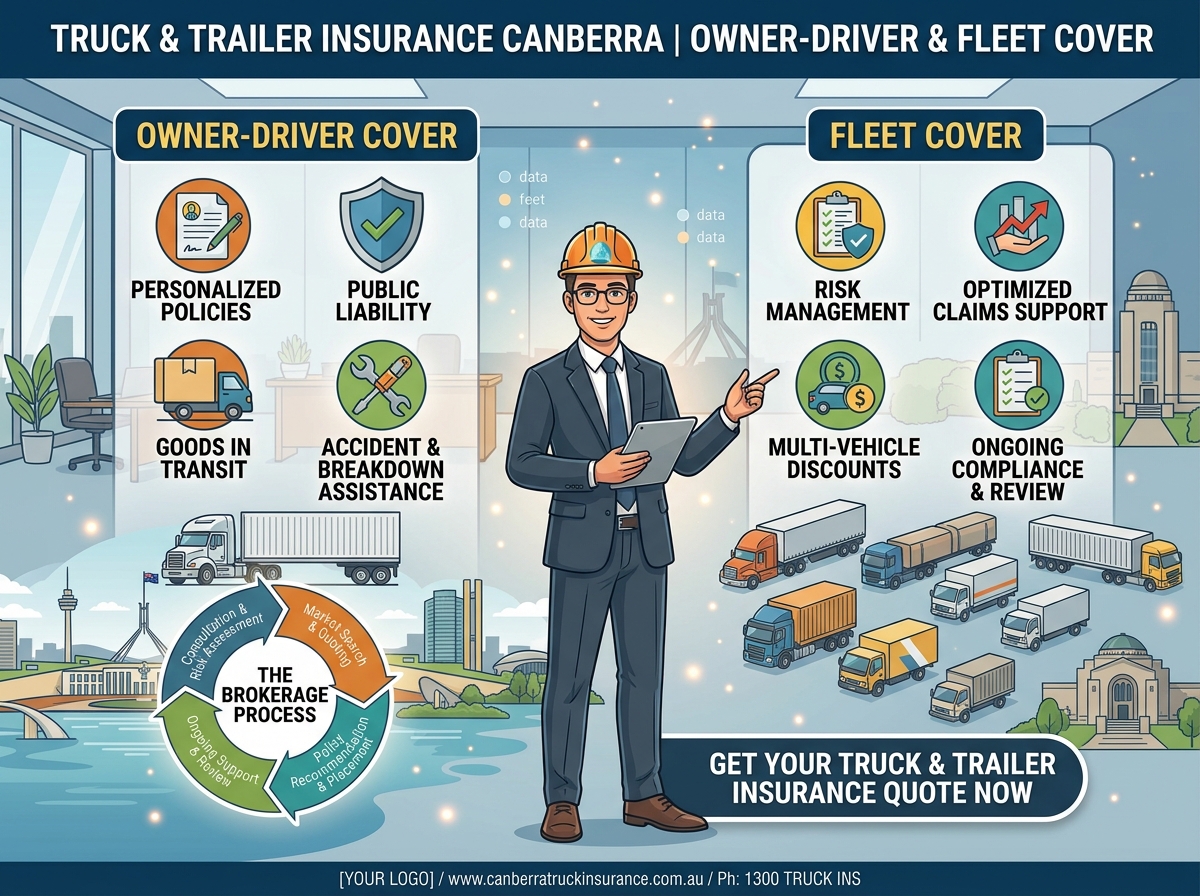
Transport companies may need to consider commercial motor insurance, truck and trailer arrangements, goods in transit and fleet protection.
The requirements of an owner-driver operating one vehicle can differ from those of a company managing several trucks and employees.
Reviewing these arrangements together can help identify potential gaps between motor insurance, cargo protection and business liability.
See truck and transport insurance for relevant information.
5. How a Broker Helps Compare Business Insurance Policies
One of the reasons businesses approach an insurance broker is to understand the differences between policies that may initially appear similar.
Two quotes can have different premiums but also different limits, exclusions, excesses and conditions.
Looking at the price alone may not provide enough information to make a suitable decision.
Compare the Coverage, Not Just the Premium
Suppose a Canberra business receives two public liability insurance quotations.
One has a lower premium, while the other is more expensive.
Before choosing either option, the business should compare:
- The limit of indemnity.
- The insured business activities.
- Relevant exclusions.
- Excess amounts.
- Territorial limits.
- Products liability arrangements.
- Legal and defence cost provisions.
- Contractual requirements.
- Applicable policy conditions.
The same approach applies to professional indemnity, property insurance and commercial motor insurance.
Understand the Difference Between Insurance Products
A business may require more than one policy because different insurance products are designed to address different risks.
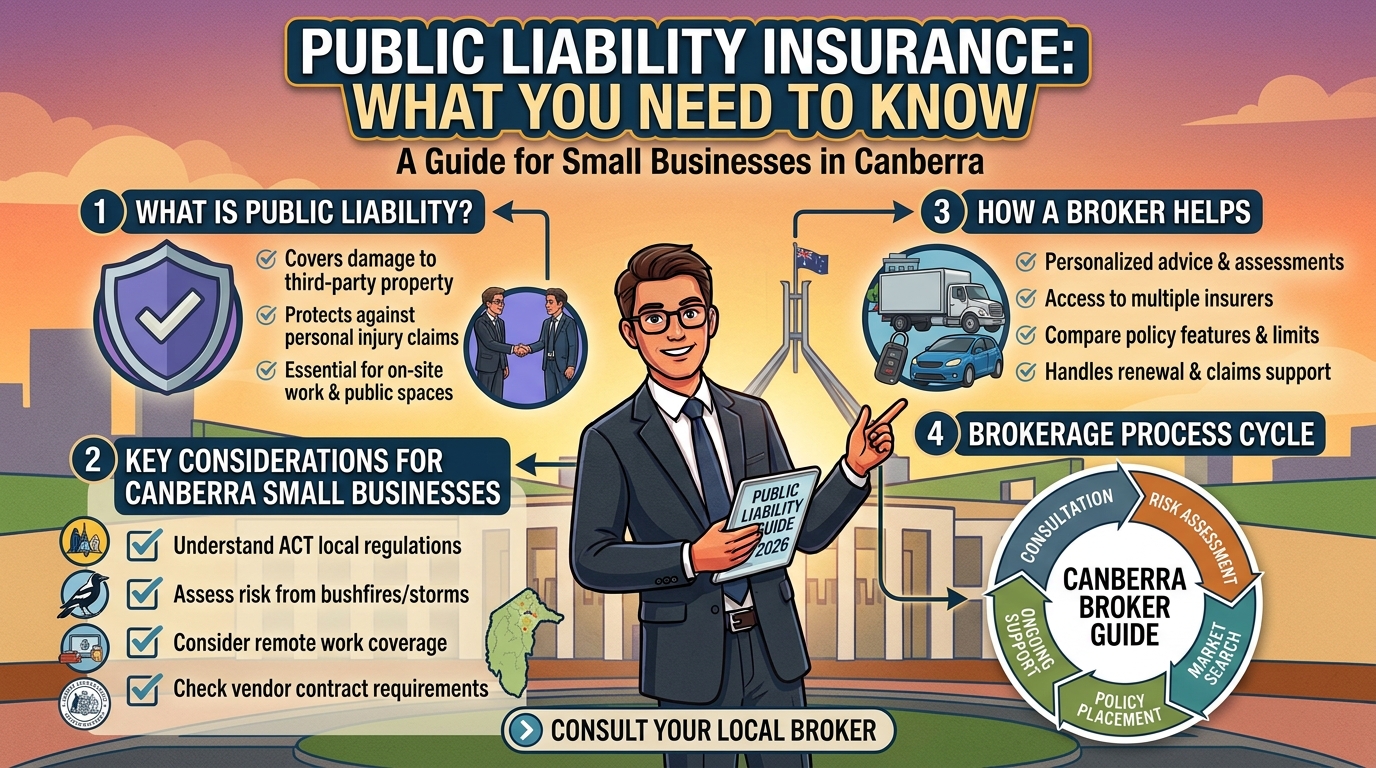
Public liability insurance generally addresses certain claims involving third-party injury or property damage arising from business activities.
Professional indemnity insurance addresses certain claims alleging financial loss arising from professional advice or services.
Commercial motor insurance addresses specified risks involving vehicles used for business.
Business property insurance may cover eligible buildings, equipment, contents and stock.
Business interruption insurance may help with specified financial losses or additional expenses following an insured interruption.
A business should not assume that buying one policy automatically protects everything it owns or does.
You can review the broker's business insurance options for more information.
6. What Should You Ask Before Working With a Canberra Insurance Broker?
Before engaging a business insurance broker in Canberra, take time to understand the service being offered.
The questions below can help establish whether the brokerage is suitable for your requirements.
Is the Broker Properly Authorised?
Insurance brokers providing financial services in Australia must operate under the relevant Australian Financial Services Licence arrangements or authorisations.
You can check an insurer or broker's relevant AFS licence or authorised representative details through the ASIC Professional Registers.
Check the services the business is authorised to provide rather than relying solely on a website description.
Which Insurers and Markets Can the Broker Access?
Ask which insurers or underwriting markets may be approached for your particular business risk.
A broker's market access can vary depending on the type of insurance, insurer relationships and underwriting requirements.
Do not assume every broker has access to every available insurance product.
How Is the Broker Remunerated?
Ask whether the broker receives commission, charges a service fee or uses another remuneration arrangement.
Review the relevant Financial Services Guide or other applicable disclosure information. ASIC provides guidance about the disclosure of remuneration, commissions and relationships.
You can read the ASIC guidance on Financial Services Guides.
What Happens During a Claim?
Ask what assistance the broker provides if you need to make a claim.
Clarify whether the service includes helping you understand notification requirements, submitting documents, communicating with the insurer or following up on the progress of a claim.
Claim assistance should never be confused with a guarantee that the insurer will accept or pay a claim.
How Often Will the Insurance Be Reviewed?
Business insurance should be reviewed when circumstances change and before renewal.
A good review should consider changes to turnover, staffing, premises, equipment, contracts, vehicles and business activities.
The service.gov.au business insurance guidance also recommends reviewing policies when a business changes and understanding the terms, exclusions and conditions in its policy documents.
7. Why Local ACT Knowledge Matters When Arranging Business Insurance
A Canberra insurance broker should understand the local business environment and the insurance requirements relevant to ACT operations.
This does not mean every Canberra business needs the same collection of policies.
A business operating in Griffith, a retailer in Belconnen, a contractor working across construction sites and a transport operator based in Hume may have very different exposures.
There are also specific regulatory considerations.
For example, employers in the ACT must maintain an appropriate workers compensation policy with an approved insurer, subject to applicable requirements.
This is separate from ordinary public liability insurance.
The ACT Government's business protection guidance explains compulsory insurance considerations and other types of insurance that businesses may need to review.
Understand Your Legal and Contractual Requirements
Insurance obligations can arise from legislation, licences, industry requirements and commercial contracts.
Businesses should distinguish between compulsory insurance and cover that is recommended or required by a customer contract.
For example, public liability may be required by a venue or contractor agreement even when it is not a universal legal requirement for every type of business.
Understanding the difference helps avoid buying unnecessary cover while ensuring relevant obligations are addressed.
8. When Is Buying Direct a Suitable Option?
Working with a broker is not essential for every insurance purchase.
A business may be comfortable buying directly if its risk is straightforward, it understands the product and it can confidently compare the policy terms.
Direct purchasing may be worth considering when:
- You need one clearly defined insurance product.
- Your business activities are straightforward.
- You understand the relevant exclusions and conditions.
- You are comfortable comparing policy documents.
- You can manage renewals and changes independently.
However, additional support may be valuable when the business has multiple locations, specialist machinery, several vehicles, complex contracts or unusual liability exposures.
There is no universal answer. The right choice depends on the work involved and the insurance arrangements available.
9. Information to Prepare Before Requesting Business Insurance
Whether you approach an insurance company directly or contact a Canberra insurance broker, accurate information can make the process more efficient.
Consider preparing the following.
Business informationDetails to prepareBusiness identityBusiness name, structure and ABNOperationsProducts, services and business activitiesFinancial informationAnnual turnover and relevant payroll detailsEmployeesNumber of workers and contractorsPremisesBusiness address, building and contents detailsEquipmentMachinery, tools and equipment valuesVehiclesVehicle types, values, drivers and commercial useContractsCustomer insurance requirements and liability limitsClaimsRelevant claims historyExisting insuranceCurrent policies, limits, exclusions and renewal dates
For hospitality operators, include details about food preparation, commercial kitchen equipment, seating arrangements, deliveries and stock.
For transport businesses, provide accurate information about vehicles, drivers, trailers, cargo and operating areas.
The quality of the information supplied can influence how insurers assess the risk and what terms they offer.
10. How Canberra Insurance Brokers Approaches Business Insurance
Canberra Insurance Brokers lists business insurance, public liability, professional indemnity, transport, commercial property, cyber and café and restaurant insurance among its available insurance solutions.
Its website describes a three-step process:
Connect: Contact the brokerage and discuss your insurance requirements.
Compare: Review available insurance options and quotes from relevant insurers.
Arrange cover: Receive policy documentation once the selected arrangement is in place.
The brokerage also provides information for sole traders, contractors and businesses with different commercial insurance requirements.
To explore these options, visit Canberra Insurance Brokers or contact the team through its enquiry page.
The appropriate solution depends on your business circumstances, insurer availability and the terms of the policy selected.
Frequently Asked Questions
Is it better to use an insurance broker or buy business insurance directly?
It depends on your insurance requirements. Buying directly may suit businesses with straightforward needs and a clear understanding of the policy. A broker may be useful when comparing multiple insurance options, managing several policies or reviewing specialised business risks.
Can an insurance broker compare quotes from multiple insurers?
Yes, brokers can access insurance products from multiple insurance companies, depending on their authorisations and market access. They should explain which markets have been approached and what limitations apply to the comparison.
Does using a Canberra insurance broker cost more?
Broker remuneration arrangements vary. Some brokers receive commission from insurers, some charge fees and some use a combination. Ask for clear information about fees, commissions and other relevant remuneration before proceeding.
What insurance does a small business in Canberra need?
It depends on the business. Common considerations include public liability, property, workers compensation, professional indemnity, commercial motor, product liability, cyber and business interruption insurance. Legal obligations and contractual requirements should also be reviewed.
Can a business insurance broker help with public liability and professional indemnity?
A broker may help assess and compare both policies, depending on the services they are authorised to provide. Public liability and professional indemnity address different types of claims, so they should not be treated as interchangeable.
Should I change brokers when my business grows?
Not necessarily. Start by reviewing whether your existing insurance arrangements still meet your business needs. If you require different expertise, services or insurer access, compare alternative brokerage options before making a decision.
How often should I review business insurance?
Review it before renewal and whenever there is a material business change. Moving premises, increasing staff, buying equipment, launching new services and entering larger contracts can all affect your insurance requirements.
How can I find a business insurance broker in Canberra?
Look for an appropriately authorised broker with relevant business insurance experience. Ask about insurer access, remuneration, policy comparisons, renewal support and claims assistance. You can also use ASIC's Professional Registers to check relevant authorisation details.
Making the Right Business Insurance Decision in Canberra
Choosing between a broker and buying business insurance directly should come down to the complexity of your business, the support you need and the available insurance options.
Some businesses will be comfortable arranging straightforward insurance directly. Others may benefit from a broker who can help assess different risks, compare available policies and support ongoing insurance reviews.
For Canberra business owners, the most important step is to understand exactly what needs protecting.
A contractor should consider the activities performed at customer premises. A restaurant needs to consider customers, products, equipment and stock. A transport business needs to review its commercial vehicles, cargo and liability exposures. Professional service providers may need to assess their exposure to claims involving advice or specialist services.
An informed decision should always consider policy coverage, limits, exclusions, conditions and costs together.
Canberra Insurance Brokers provides information and insurance options for local businesses across Canberra and the ACT.
Visit canberrainsurancebrokers.com.au or call 1300 069 570 to discuss your business insurance requirements.
Important information: This article provides general information only and does not take account of your objectives, financial situation or needs. Insurance products, broker services, authorisations, insurer availability and remuneration arrangements vary. Read the relevant Financial Services Guide, Product Disclosure Statement and policy wording, and consider whether the proposed cover is appropriate for your circumstances before making a decision.
Author: Canberra Insurance Brokers Editorial Team
Last updated: 26 November 2026
















Get in Touch With Us
Have questions about insurance? Our experienced brokers are here to help you find the right coverage.