
Truck and Trailer Insurance Canberra: What Owners and Operators Should Know
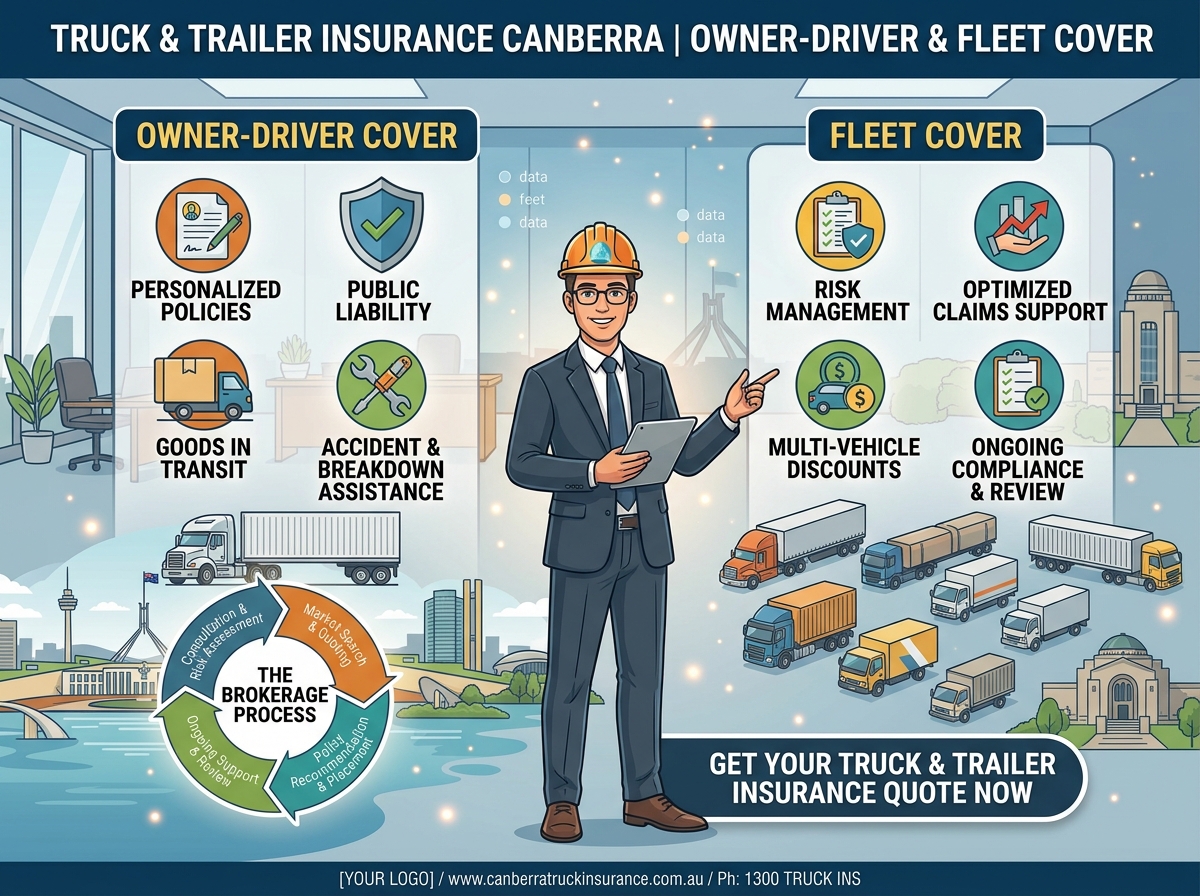
If you own a truck, operate a trailer, run a transport business or drive your own vehicle as an owner-operator, insurance is not something you want to figure out after an accident.
Your truck might be your main source of income. The trailer may be carrying goods worth thousands of dollars. A breakdown can disrupt a delivery schedule, while a serious accident can affect the vehicle, cargo, business and people involved.
That is why choosing the right truck and trailer insurance Canberra businesses and operators can rely on starts with understanding how the vehicle is actually used.
A rigid truck making local deliveries has different risks from a prime mover travelling interstate with a semi-trailer. A refrigerated truck carrying temperature-sensitive freight needs a different conversation from a tipper used on construction sites. A single owner-driver may have very different needs from a transport company managing a fleet.
For Canberra operators, there is another reason to pay attention to the details in 2026. The Heavy Vehicle National Law changed on 1 August 2026, with changes covering areas including heavy vehicle accreditation, fatigue requirements, work diary record-keeping and mass, dimension and loading provisions.
Those regulatory changes are not the same thing as insurance, but they reinforce a simple point: your transport business needs to be described accurately when you arrange insurance.
This guide looks at truck insurance Canberra operators may need, how truck and trailer cover works, what owner-drivers and fleet operators should consider, and the questions worth asking an insurance broker before choosing a policy.
What Is Truck and Trailer Insurance?
Truck and trailer insurance is a broad term covering insurance arrangements for commercial trucks, trailers and related transport operations.
The actual policy can vary depending on the vehicle, business activity, driver arrangements, cargo, operating area and insurer.
For a transport business, insurance may involve several separate areas rather than one policy covering everything.
Depending on the circumstances, a business may need to consider:
- Truck or commercial motor insurance
- Trailer insurance
- Third-party liability
- Goods in transit or cargo insurance
- Public liability
- Business interruption
- Equipment or tools
- Fleet insurance
- Workers compensation
- Personal accident or income-related protection for owner-drivers
- Other specialist transport covers
Business.gov.au identifies transportation vehicles and vessels, equipment and machinery, cargo and goods, property and buildings, and business interruption among the insurance considerations for the transport, postal and warehousing industry.
The important part is understanding how the different pieces fit together.
Why Truck Insurance Is Different From Ordinary Car Insurance
A commercial truck can be worth significantly more than a private passenger vehicle, but the difference is not just the value of the vehicle.
It is also how the truck is used.
A commercial truck may:
- Travel long distances
- Carry heavy or specialised loads
- Tow a trailer
- Operate on construction sites
- Make repeated deliveries
- Cross state borders
- Carry temperature-sensitive goods
- Be driven by several authorised drivers
- Operate as part of a fleet
The insurer therefore needs an accurate picture of the risk.
For example, a truck used for local landscaping deliveries may present a different risk from a prime mover hauling freight between Canberra, Sydney and Melbourne.
That is why a proper commercial truck insurance Canberra discussion starts with the operation rather than simply the make, model and purchase price of the vehicle.
What Does Truck Insurance Typically Protect?
The answer depends on the policy selected.
Canberra Insurance Brokers' current transport insurance page describes options for truck owners, owner-operators, fleet operators and commercial vehicles, with cover that can address areas including vehicle damage, third-party liability, theft, vandalism, natural disasters and certain transport-related exposures.
Common areas a truck owner may discuss include:
Accidental damage
Cover for eligible damage to the insured truck following an insured event.
Theft
Protection for theft of the insured vehicle where the policy responds.
Fire
Cover for eligible fire damage.
Third-party liability
Protection for certain legal liabilities arising from vehicle use, subject to the policy.
Trailer cover
Insurance for trailers may need to be specifically considered, especially where the business owns several trailer types.
Fleet insurance
A fleet arrangement may be suitable where a business operates multiple commercial vehicles.
Goods in transit
This is a separate area worth discussing if the business carries customers' goods or its own goods.
The policy wording determines exactly what is covered.
Truck and Trailer Insurance Canberra: Why the Trailer Matters
It is easy to focus on the truck and forget the trailer.
But a trailer can represent a significant investment and may be essential to the operation.
A transport business could operate with:
- Box trailers
- Semi-trailers
- Flatbeds
- Curtainsiders
- Refrigerated trailers
- Tippers
- Specialist trailers
- Equipment trailers
The right insurance arrangement depends on ownership, how the trailer is used and the particular policy.
Ask your broker:
Is the trailer separately insured?
Is it covered while attached to the truck?
What happens when it is detached?
What happens if another truck operates it?
Are accessories and specialised fittings covered?
Does the policy reflect the replacement value?
These details can become particularly important for operators who use several trucks and trailers interchangeably.
Owner Driver Truck Insurance Canberra
An owner-driver operates a business around a vehicle they own or control rather than working solely as an employee driver.
For many owner-drivers, the truck is effectively the business.
If the truck is unavailable, the income stream may stop almost immediately.
That makes the structure of owner driver truck insurance Canberra particularly important.
An owner-driver should think about more than the truck
Consider what happens if:
- The truck is damaged in a crash
- The truck is stolen
- A major repair takes weeks
- A trailer is damaged
- A customer cancels a job because the vehicle is unavailable
- A load is damaged
- A contract requires specific liability limits
- The operator is unable to work
Not all of those risks are automatically covered by one motor policy.
This is why owner-drivers should discuss the wider business impact with an insurance broker rather than simply asking for the cheapest truck premium.
How Owner-Driver Insurance Can Differ From Fleet Insurance
A single-truck operator and a fleet business may have similar vehicles but different insurance needs.
A fleet operator might have:
- Multiple trucks
- Several drivers
- Different vehicle classes
- Different operating routes
- Shared trailers
- Centralised maintenance
- Higher annual turnover
A fleet truck insurance Canberra arrangement may therefore be structured differently from a single-vehicle policy.
Fleet insurance can also simplify administration when multiple vehicles are insured under a coordinated arrangement, although the suitability depends on the business and insurer.
When adding or removing vehicles, the business should keep its insurance information up to date.
Business.gov.au recommends reviewing business insurance when circumstances change, including when equipment or vehicles are bought or sold.
Heavy Vehicle Insurance Canberra: What Operators Need to Know
The term heavy vehicle insurance Canberra covers a wide range of commercial transport operations.
The vehicle might be:
- A rigid truck
- A prime mover
- A road train combination where applicable
- A heavy trailer combination
- A specialised heavy vehicle
- A refrigerated vehicle
- A tipper
- A tow truck
- A pantech
- A flatbed
The insurance conversation should reflect the vehicle's actual use.
The NHVR defines a fatigue-regulated heavy vehicle as a vehicle or combination with a gross vehicle mass over 12 tonnes, with specific fatigue obligations applying under the Heavy Vehicle National Law.
That is a useful reminder that transport insurance sits alongside a much wider compliance environment.
Insurance does not replace safe operation, maintenance, loading, fatigue management or legal compliance.
What Changed for Heavy Vehicle Operators in 2026?
This is one of the areas worth adding to a current Canberra truck insurance guide.
The Heavy Vehicle National Law and Regulations changed on 1 August 2026.
The NHVR says the reforms include:
- A new Heavy Vehicle Accreditation scheme
- Updates to fatigue requirements
- Simplified work diary record-keeping
- Changes to mass, dimension and loading provisions
The NHVR also explains that the new Heavy Vehicle Accreditation scheme replaced the previous NHVAS arrangements for new accreditation applications from 1 August 2026.
What does that have to do with insurance?
The law and insurance are separate.
A policy does not make an operator compliant with heavy vehicle law.
However, changes to the operation, vehicle configuration, routes, loads, drivers or business processes can be relevant information when reviewing insurance.
That is why an operator should tell their broker about material operational changes rather than assuming an old policy description still accurately reflects the business.
Prime Mover Insurance Canberra
A prime mover can be one of the most valuable assets in a transport business.
It may also spend a significant amount of time on the road, often over long distances and under demanding operating conditions.
Prime mover insurance Canberra should therefore be discussed in the context of the complete operation.
Questions to consider
What does the prime mover tow?
The trailer type matters.
Where does it travel?
Is it local, regional, interstate or a combination?
What type of freight is carried?
General freight and specialised freight can create different considerations.
Who drives it?
One driver or multiple authorised drivers?
What are the downtime consequences?
If the prime mover is unavailable, what happens to the business?
What contract requirements exist?
Large transport customers may specify minimum insurance requirements.
These questions help move the conversation away from “How much does prime mover insurance cost?” and toward “What insurance structure makes sense for this operation?”
Refrigerated Truck Insurance Canberra
A refrigerated truck is not just another truck.
The vehicle may carry food, pharmaceuticals or other temperature-sensitive products where maintaining the right conditions is essential.
That means the insurance discussion may involve more than physical damage to the truck.
A refrigerated operation should ask about:
- Refrigeration equipment
- Cargo
- Temperature-sensitive goods
- Breakdown scenarios
- Business interruption
- Goods in transit
- Loading and unloading
- Theft
- Vehicle damage
Canberra Insurance Brokers currently lists refrigerated trucks among the specialist transport vehicles it supports and identifies tailored trucking options for these operations.
A practical example
Imagine a refrigerated truck carrying a high-value delivery from Canberra to Sydney.
The truck has a mechanical problem midway through the journey.
There may be several separate financial questions:
What happens to the truck?
What happens to the refrigeration unit?
What happens to the cargo?
Who is responsible for the loss?
What insurance policy responds?
That is why transport operators should understand the difference between vehicle insurance and goods-in-transit insurance.
Truck and Trailer Insurance vs Goods in Transit Insurance
These are not necessarily the same thing.
Truck insurance
Generally focuses on the insured commercial vehicle and specified risks associated with it.
Goods in transit insurance
Can address eligible loss or damage to goods being transported, depending on the policy.
The distinction matters because a transport operator can have a truck fully insured while the cargo has a separate exposure.
Business.gov.au specifically identifies cargo and goods as a separate insurance consideration within the transport industry.
Ask your broker:
Who owns the goods?
What are you contractually responsible for?
What kind of cargo do you carry?
Are there value limits?
Are there exclusions for certain goods?
Does cover apply during loading and unloading?
These questions can reveal gaps that are easy to miss.
Loading and Unloading Risks
A truck does not only create risk while it is driving.
Loading and unloading can also be part of the transport operation.
This is particularly important for businesses that load heavy, valuable or specialised goods.
The NHVR's Chain of Responsibility framework recognises multiple parties involved in heavy vehicle transport, including employers, operators, schedulers, consignors, consignees, loaders and unloaders.
The NHVR also states that the primary duty of Chain of Responsibility parties includes managing safety risks associated with their transport activities.
From an insurance perspective, the practical lesson is simple:
Do not describe your business only as “truck driving.”
Tell your broker about loading, unloading, depots, customers, subcontractors and other parts of the transport operation.
What Is Chain of Responsibility and Why Should Truck Operators Understand It?
Chain of Responsibility, often abbreviated to CoR, is part of the heavy vehicle safety framework.
You can be a party in the CoR because of the function you perform, not simply because your job title says “truck driver” or “transport operator.”
The NHVR identifies ten relevant functions, including employer, prime contractor, operator, scheduler, consignor, consignee, packer, loading manager, loader and unloader.
An owner-driver who owns and drives a heavy vehicle is an operator and therefore a party in the CoR.
This matters because transport insurance should be considered alongside the way your business actually operates.
Good transport risk management includes:
- Safe loading
- Correct load restraint
- Vehicle maintenance
- Appropriate scheduling
- Fatigue management
- Driver fitness
- Accurate records
- Clear responsibilities
Insurance cannot be used as a substitute for any of these.
Heavy Vehicle Loading and Mass Requirements
Heavy vehicle operators need to understand the requirements that apply to their vehicles and routes.
In August 2026, the NHVR published an ACT Higher Mass Limits declaration covering eligible heavy vehicles on specified areas and routes. It applies to vehicle types including rigid trucks, prime movers and semitrailers, among others, subject to the conditions of the declaration.
The declaration does not remove other HVNL requirements.
The NHVR specifically notes that loading must keep the heavy vehicle safe and stable, prevent the load from falling or becoming dislodged, and use an appropriate load restraint system.
Why include this in an insurance article?
Because your risk profile depends partly on what your truck actually does.
An operator carrying heavy construction materials has a different exposure from one carrying light parcels.
A refrigerated transport business has different cargo risks from a furniture mover.
A prime mover carrying interstate freight has different operating circumstances from a local rigid truck.
Your insurance should be based on reality.
Transport Insurance Canberra: What Other Cover Might Be Relevant?
Truck insurance is only one part of transport insurance.
Depending on the business, you may also need to consider:
Public liability
For certain third-party injury or property damage risks.
Goods in transit
For eligible loss or damage to cargo.
Trailer insurance
For owned trailers and relevant trailer risks.
Business interruption
Where a covered event causes interruption to the business.
Equipment
For tools, machinery and other transport-related equipment.
Workers compensation
For eligible workers employed by the business.
Personal accident or income protection
Especially worth discussing for owner-drivers who depend directly on their ability to work.
Business.gov.au identifies several of these insurance categories as relevant to businesses and the transport industry.
What Does Commercial Truck Insurance Canberra Cost?
There is no standard price for commercial truck insurance Canberra operators.
The premium can be influenced by many factors.
Vehicle
A rigid truck, prime mover, refrigerated truck and specialist truck can present different risks.
Vehicle value
A more expensive vehicle can create a larger potential claim.
Usage
Local delivery and interstate freight can have different operating profiles.
Driver details
Insurer requirements can include driver information and experience.
Claims history
Previous claims can influence underwriting.
Cargo
The goods being transported may matter.
Security
Where and how the truck is stored can be relevant.
Coverage
Higher limits and additional features can affect the premium.
Business size
A fleet operator may have different risk and pricing considerations from a single owner-driver.
This means asking for a generic “truck insurance price” without providing details usually will not produce a useful answer.
Should You Choose the Cheapest Truck Insurance?
Not necessarily.
Transport operators understandably want to control costs.
But the cheapest premium can become expensive if the policy does not match the business.
Before comparing quotes, look at:
- Vehicle coverage
- Liability limits
- Trailer coverage
- Theft
- Fire
- Accident damage
- Additional benefits
- Exclusions
- Excess
- Driver conditions
- Usage restrictions
- Claims process
Business.gov.au advises business owners to understand their policy, read the Product Disclosure Statement and review insurance regularly as the business changes.
The better question is:
“Does this policy give my transport business the protection I actually need?”
Fleet Truck Insurance Canberra: When Does It Make Sense?
A fleet can include two vehicles or many more, depending on the business and insurer.
Fleet arrangements may simplify administration and allow a business to manage multiple commercial vehicles under a coordinated insurance structure.
But fleet insurance still needs accurate vehicle information.
When adding a new truck, tell your broker:
- Vehicle type
- Value
- Use
- Driver arrangements
- Territory or interstate operation
- Cargo
- Security
- Any specialised modifications
When selling a truck, make sure the policy is updated too.
This sounds basic, but keeping vehicle records accurate is one of the easiest ways to keep your insurance aligned with the business.
What Happens If a Truck Is Damaged?
The immediate concern after an accident is safety.
Once everyone is safe and any emergency requirements are handled, the insurance process begins.
Business.gov.au recommends contacting the insurer as soon as possible after a claim and checking the policy for any time limits that apply. It also notes that insurers may request photographs, proof of ownership, records and contracts.
For a truck claim, keep useful information such as:
- Photos of the damage
- Vehicle details
- Registration information
- Incident details
- Police information where applicable
- Driver details
- Repair estimates
- Recovery or towing records
- Cargo information
- Relevant contracts
- Witness details
Do not assume that every repair should be authorised independently.
Check your policy and speak with the insurer or broker about the correct claims process.
What If the Truck Is Off the Road?
For many transport operators, downtime is almost as important as the physical damage.
A truck may be the asset that generates the revenue.
If it is unavailable, the business may have to:
- Hire another vehicle
- Outsource work
- Delay deliveries
- Move freight through another operator
- Pay additional operating costs
- Deal with customer penalties or contract issues
This is where business interruption or other specific policy benefits may deserve consideration.
Do not assume that every truck insurance policy automatically covers lost income simply because the vehicle has been damaged.
Ask the question before you need the answer.
Interstate Truck Operations From Canberra
Canberra sits close to New South Wales, and many local transport businesses operate beyond the ACT.
An operator might regularly travel between Canberra and:
- Sydney
- Regional New South Wales
- Melbourne
- Other interstate destinations
When transport operations cross borders, tell your broker.
The operating territory, routes, vehicle configuration, cargo and driver arrangements can all be relevant to the insurance discussion.
And because heavy vehicle operators work under national regulatory arrangements, keeping up with current rules matters.
The 2026 HVNL reforms are a good example: the NHVR says changes took effect from 1 August 2026 across accreditation, fatigue, record-keeping, and mass, dimension and loading requirements.
MAI Insurance and Truck Insurance Are Not the Same Thing
Canberra has its own Motor Accident Injuries, or MAI, scheme.
The ACT Treasury explains that the MAI scheme replaced the former CTP scheme in February 2020 and provides compulsory personal injury insurance for motor vehicle accidents.
This is important for truck operators because compulsory motor accident injury cover is not the same thing as voluntary commercial truck insurance.
In simple terms:
MAI insurance is about compulsory motor accident personal injury protection under the ACT scheme.
Commercial truck insurance can address eligible risks involving the insured vehicle and other policy benefits, depending on the policy.
Goods in transit insurance concerns eligible cargo risks.
Public liability insurance deals with certain third-party liabilities arising from business activities.
Each serves a different purpose.
Do not assume that registration-related insurance replaces commercial vehicle cover.
Questions to Ask a Canberra Insurance Broker About Your Truck
Before accepting a truck insurance quote, ask:
Is my actual truck use covered?
Be specific about local and interstate work.
Is the trailer covered?
Find out whether the trailer needs separate cover or is included in the arrangement.
What happens if the truck is stolen?
Ask how the policy responds and what conditions apply.
What happens after an accident?
Understand the claims and repair process.
Is loading and unloading covered?
Ask about the actual policy wording.
Is my cargo insured?
Do not assume truck insurance automatically means goods in transit cover.
What happens if a new driver uses the truck?
Check driver conditions before allowing changes.
Are modifications covered?
Specialised equipment and modifications should be disclosed.
Does the policy reflect my business contracts?
Some clients require particular liability limits or insurance conditions.
What should I review each year?
Ask what changes should trigger a mid-term policy review.
A Truck Insurance Checklist for Canberra Operators
Before arranging or renewing insurance, prepare the following.
Vehicle details
- Make and model
- Year
- GVM or relevant rating
- Vehicle value
- Modifications
- Accessories
Trailer details
- Trailer type
- Value
- Ownership
- Intended use
- Specialised equipment
Business details
- Annual turnover
- Type of freight
- Operating area
- Interstate travel
- Number of vehicles
- Number of drivers
Driver information
- Driver experience
- Permitted drivers
- Any material changes
Claims
- Previous incidents
- Previous insurance claims
Contracts
- Client insurance requirements
- Liability limits
- Certificate requirements
Cargo
- Type of goods
- Typical value
- Special handling
- Temperature requirements
Having this information ready can make the quoting and review process much easier.
Common Truck Insurance Mistakes
Insuring the truck but ignoring the trailer
The trailer can represent a significant financial exposure.
Forgetting about the cargo
Vehicle insurance does not automatically mean cargo is insured.
Choosing a generic vehicle description
A specialised truck needs to be described accurately.
Failing to mention interstate work
Operating territory can matter.
Not updating the policy after buying a new truck
New vehicles should be added promptly.
Ignoring modifications
Specialised equipment or modifications should be disclosed.
Treating insurance as a replacement for compliance
It is not.
Choosing purely on price
Coverage matters.
Frequently Asked Questions About Truck and Trailer Insurance Canberra
What is truck and trailer insurance?
It refers broadly to insurance arrangements for commercial trucks and trailers. The actual cover depends on the policy and may include vehicle damage, theft, third-party liability, trailer cover and other benefits.
What does truck insurance cover?
Depending on the policy, truck insurance may cover eligible loss or damage arising from accidents, fire, theft, vandalism and other insured events, together with specified liability protection. Always check the policy wording.
Do I need separate trailer insurance?
It depends on the ownership arrangement and policy. Ask your broker specifically whether each trailer is covered and under what circumstances.
What is commercial truck insurance Canberra?
It is insurance arranged for trucks used in commercial business operations in Canberra and elsewhere, with cover based on the vehicle, use, drivers, cargo and policy terms.
What is owner-driver truck insurance Canberra?
It refers to truck insurance arrangements for people who own and operate their own commercial truck as part of their business.
What is fleet truck insurance?
Fleet insurance is an arrangement for businesses operating multiple commercial vehicles. Whether it is suitable depends on the size and structure of the fleet and the insurer.
What is prime mover insurance?
Prime mover insurance refers to commercial insurance for prime movers, which are designed to tow trailers. The policy should reflect how the vehicle operates and what it tows.
Does truck insurance cover goods in transit?
Not automatically. Goods in transit can be a separate insurance consideration and should be discussed based on the goods being transported and your contractual responsibilities.
Is truck insurance the same as MAI insurance?
No. The ACT's MAI scheme provides compulsory motor accident personal injury insurance. Commercial truck insurance serves different purposes and can address eligible vehicle-related risks, depending on the policy.
How much does truck insurance cost in Canberra?
There is no standard price. Premiums can depend on vehicle type and value, use, cargo, drivers, operating territory, claims history, coverage and other underwriting factors.
Can one policy cover several trucks?
Fleet insurance may allow multiple vehicles to be insured under a coordinated arrangement, subject to the insurer and policy.
Can Canberra truck insurance cover interstate travel?
Some policies can cover interstate operations, but the actual territory and conditions need to be confirmed with the insurer or broker.
What should I do after a truck accident?
Prioritise safety and any required emergency or reporting actions, then contact the insurer as soon as practical and follow the policy's claims process. Keep photographs, incident details and relevant documents.
How to Choose Truck Insurance in Canberra
The best starting point is not the cheapest quote.
Start by describing the operation honestly.
Tell your broker:
What truck do you have?
What does it carry?
Where does it travel?
Who drives it?
What trailer does it tow?
Do you operate a fleet?
Do you carry customers' goods?
Do you cross state borders?
What happens to your business if the truck is off the road?
Those answers provide a much more useful foundation for comparing insurance.
Business.gov.au recommends speaking with licensed brokers or insurers and reviewing the policy documentation carefully. It also recommends checking insurance regularly when your business changes, including when vehicles or equipment are bought or sold.
Final Thoughts: Protecting a Truck-Based Business in Canberra
For a transport business, the truck is rarely just another asset sitting in the yard.
It may be the business.
It gets you to customers, moves freight, generates invoices and keeps contracts running.
That is why truck and trailer insurance Canberra operators choose should reflect the real way the business works.
A local owner-driver may need a different solution from a company running a fleet.
A rigid truck making daily Canberra deliveries may have different requirements from a prime mover travelling interstate.
A refrigerated truck carrying temperature-sensitive freight has different cargo considerations from a tipper moving construction materials.
And a transport company cannot look at vehicle insurance in isolation from cargo, liability, business interruption and regulatory responsibilities.
In 2026, heavy vehicle operators also need to keep the broader regulatory picture in mind. The NHVR's Heavy Vehicle National Law reforms took effect on 1 August 2026 and introduced changes to accreditation, fatigue, work diary record-keeping, and mass, dimension and loading arrangements.
For Canberra operators, understanding those obligations is part of running a safe transport business. Insurance is another part.
The strongest approach is to review both together:
How do we operate?
What can go wrong?
What are we legally responsible for?
What assets and cargo do we need to protect?
What insurance responds to those risks?
If you are searching for truck insurance Canberra, truck and trailer insurance Canberra, commercial truck insurance Canberra, owner driver truck insurance Canberra, heavy vehicle insurance Canberra, fleet truck insurance Canberra, prime mover insurance Canberra, or refrigerated truck insurance Canberra, start with your actual operation rather than a generic online quote.
Canberra Insurance Brokers currently provides transport insurance options for owner-drivers, fleets, prime movers, rigid trucks, refrigerated trucks, tippers, pantechs, tow trucks and truck-and-trailer combinations, and states that it compares truck insurance options from Australian insurers based on the vehicle and business requirements.
A broker can help you understand the available options, but the policy documents remain important. Before purchasing, review the Product Disclosure Statement and policy wording carefully, including exclusions, limits, conditions and excesses.
For a truck operator, the goal should not simply be to find the cheapest insurance.
The goal is to have insurance that makes sense for the truck, trailer, cargo, drivers and business you actually operate.
General advice warning: This article provides general information only and does not take into account your objectives, financial situation or needs. Insurance products have specific terms, conditions, exclusions, limits and excesses. Read the relevant Product Disclosure Statement and policy wording before purchasing insurance and consider obtaining appropriate professional advice.




.png)




Get in Touch With Us
Have questions about insurance? Our experienced brokers are here to help you find the right coverage.